Author Archives: Jenny Chandler

Unknown's avatar

About Jenny Chandler

I am a food writer and cooking teacher

Les Escargots

At last we may have found a new source of income on our doorstep, our daughter Imi is proving to be a natural with snails. There’s apparently a 3 year course in gastronomic gastropod management on offer at a specialist college in France but I think she’s already got the touch. The garden wall is the perfect breeding ground and ever since I read about snail caviar (that can apparently fetch as much as Beluga) I’m suddenly feeling rather excited about the armies that pile out of all the little crevices at the first sign of rain. Dainty  “Escargot pearls” are apparently a hit amongst Michelin-starred chefs nowadays so it’s just a question of learning how to harvest the tiny foresty-flavoured eggs.

I am joking, not about the caviar but about our snail farming aspirations, and sadly have to admit that I’m not even a huge fan of garlicky French escargots. I know that this does sound terribly pretentious, but the only snail I’ve ever truly savoured was in Heston Blumenthal‘s infamous snail porridge at The Fat Duck, but then he’s a magician. I’m sure that there are a few die-hard foragers who’d bother to go through the days of purging required to prepare their own garden snails for the pot (feeding them carrots and waiting for their pooh to turn orange is apparently the best way to check that they’ve expelled any toxins). Quite honestly I’d rather just bump them all off but I’m meeting some serious resistance. Our snails enjoy virtually protected status thanks to the father/daughter team I’m up against, and now I’m panicking about my foliage. Poisons are banned in case they harm any frogs or birds, barbaric stamping brings bad karma and there’s even a Tippex numbering system in place so that we can monitor our resident snails’ movements.

Now I find myself creeping around the garden under cover of darkness, equipped with head torch, collecting snails (barring numbers 1-42 where there is an amnesty in place) to be relocated up the road beside the Suspension Bridge. Everything was going fine until I got distracted the other night and left the snail bucket in the kitchen overnight. They’ve now all relocated and I have a new army of snails along with their unbearably huge, leopard slug cousins living in my saucepan cupboard.

Rhubarb and Lentil Curry

DSC_7634

Here’s a gratuitous blossom shot just to get yet another post about rhubarb off to a good start.  Imi and I walk under this glorious tree on the way down to school every morning and I thought I’d catch it in its pink powder-puffy prime before the rain and gale force winds set in.

I hope you’ll forgive me for returning to my pet subject but I cooked a very simple, tasty supper last night that I think you may love too. Rhubarb and lentils seem a pretty bizarre combination but you really should give this a go. The recipe comes from a good friend of mine, Celia Brooks Brown, who’s an uber-talented vegetarian food writer, cook and gardener. It’s from her book New Urban Farmer.

Pete and I did make a large dent in the lentils, but had I cooked up some rice there would have just about been enough to feed four. I was too busy collecting up the marauding snails in the garden (a head torch is mighty useful) to get around to the basmati, so we had warm flat bread instead. Served with a blob of yoghurt this makes a great, healthy and very economical supper. I reheated the leftovers and sprinkled them with some freshly sprouted lentils and radishes for my “photo shoot” today, which did spruce up the look of the lentils and added some pleasant, fresh crunch too.

Rhubarb and Lentil Curry (Serves 4)Rhubarb and lentil curry

2 tbsp olive oil
1 onion, diced
2 sticks celery, chopped
2 carrots, chopped
3 garlic cloves, thinly sliced
salt, black pepper
1 tsp ground cumin
1 tsp ground coriander
1/2 tsp crushed chilli flakes
1 handful coriander (cilantro), stalks and any roots, chopped (reserve leaves for garnish)
350 g (12 oz) rhubarb, cut into chunks
150 g (5 oz) Puy lentils
600 ml (1 pint) vegetable or chicken stock
1 – 2 tbsp dark brown sugar
To serve: steamed basmati rice or flat bread, yoghurt, coriander leaves and maybe some freshly sprouted lentils or beans.

Heat the oil in a large pan over a low heat and then add the onion, celery and carrots with a good pinch of salt and pepper. Stir from time to time and, once softening nicely, add the garlic. Stir in the spices and the coriander stalks (and roots if you have some) and cook until sizzling and spicy, 2-3 minutes.

Add the rhubarb and lentils and turn up the heat. Pour in the stock, give it all a stir , bring up to the boil and then turn down and simmer gently until the lentils are tender, about 20 minutes.

Stir in 1 tbsp sugar. Balance the seasoning (you may want more sugar). Continue to simmer gently until the lentils are soft and the rhubarb has collapsed, about 10-20 minutes.

Serve up in warm bowls with the rice and/or flatbread, yoghurt, plenty of coriander and perhaps some sprouted bits too.

Falling for Freekeh

It might seem bonkers to be writing about a grain, a green wheat infact, that’s virtually impossible to track down (I bought mine from the fabulous Ottolenghi online store) but Freekeh, Freekah, Frikeeh, Farik, or however you like to spell it, is really worth tasting. You’ll find it in Middle Eastern shops and, if you’re lucky enough to live in Bristol, at the fabulous Sweetmart. It’s tipped to be the next big “superfood” so no doubt it will be on the healthfood shop and supermarket shelves very soon too.

There’s nothing new about Freekeh, it’s been prepared in the Middle East for thousands of years but now the Aussies are on the case as well, as its popularity soars. The green wheat is harvested before it’s ripe and mature and then roasted over wood fires to remove the chaff, leaving you with stunningly smoky and nutritious grains. You can buy it cracked or whole. I went for whole grains even though they take about 30-40 minutes to cook (cracked cooks in about half the time) as I wanted to keep a bit of chew in my salad.

Our friends, the Pearsons, were meant to be coming for lunch on Sunday, but with sun on the horizon at last and our very small (let’s say bijou rather than pokey) city garden we decided to take our food to their airier, roomier and infinitely tidier abode in Tetbury. I’m not jealous at all! So we rocked up with my tripod, camera and an entire basket of cooked ingredients still requiring assembly. It was all rather idyllic, sipping chilled summery rosé whilst the children set up a woodlouse theme park in the garden and the birds seemed to be on a mission to out-chirp each other up in the leafy boughs above the terrace. After just a few minutes and a bit of minor faffing, as I took a couple of photos, we had this (and I’ll say so myself) very good salad.

Chicken, Roasted Roots and Freekeh Salad (Serves 4 as a main)

DSC_7614_2

It makes sense to cook extra vegetables whenever you’ re roasting a chicken or joint of meat. My carrots and beetroot took up a spare shelf in the oven whilst my chicken was on the go, so that the following day I had everything ready on hand for the salad.

200 g freekeh
a handful of green beans
1/2 red onion, finely diced
3 – 4 tbsp extra virgin olive oil
juice of 1 lemon
salt and pepper
2 tsps Ras al hanout  (or a mix of cumin, coriander & a pinch of cinnamon)
About 1/2 of a small roasted chicken, ideally leftovers
5 or 6 small beetroot, roasted wrapped in foil for about 30 minutes or until tender
6 small carrots, peeled and roasted with a drizzle of oil for about 20 minutes
Plenty of fresh mint and parsley

Rinse the freekeh and then pour it into a saucepan with a pinch of salt, cover in just about double its volume of water and bring it up to the boil. Give the grains a quick stir once boiling and then put on the lid and simmer for about 30-40 minutes until cooked but still slightly chewy. You may need to add a little water to the pan as you go but ideally the grains will have absorbed the water and there will be no need to drain them.

If you are using green beans, as I did, you can place a steamer on top of the freekeh and cook the beans for a few minutes on top of the pan. Refresh the beans in cool water as soon as they are tender.

Add red onion, olive oil, lemon juice, salt, pepper and the Ras al hanout whilst the freekeh is still warm so that the flavours can mingle and develop.

Once ready to serve, shred your chicken and arrange the carrots (cut in half lengthwise), the beetroot (no need to peel as long as you washed it well), the green beans and herbs over the grains. Play around with the seasoning and then I can’t help but splash a bit of extra virgin olive oil on top.

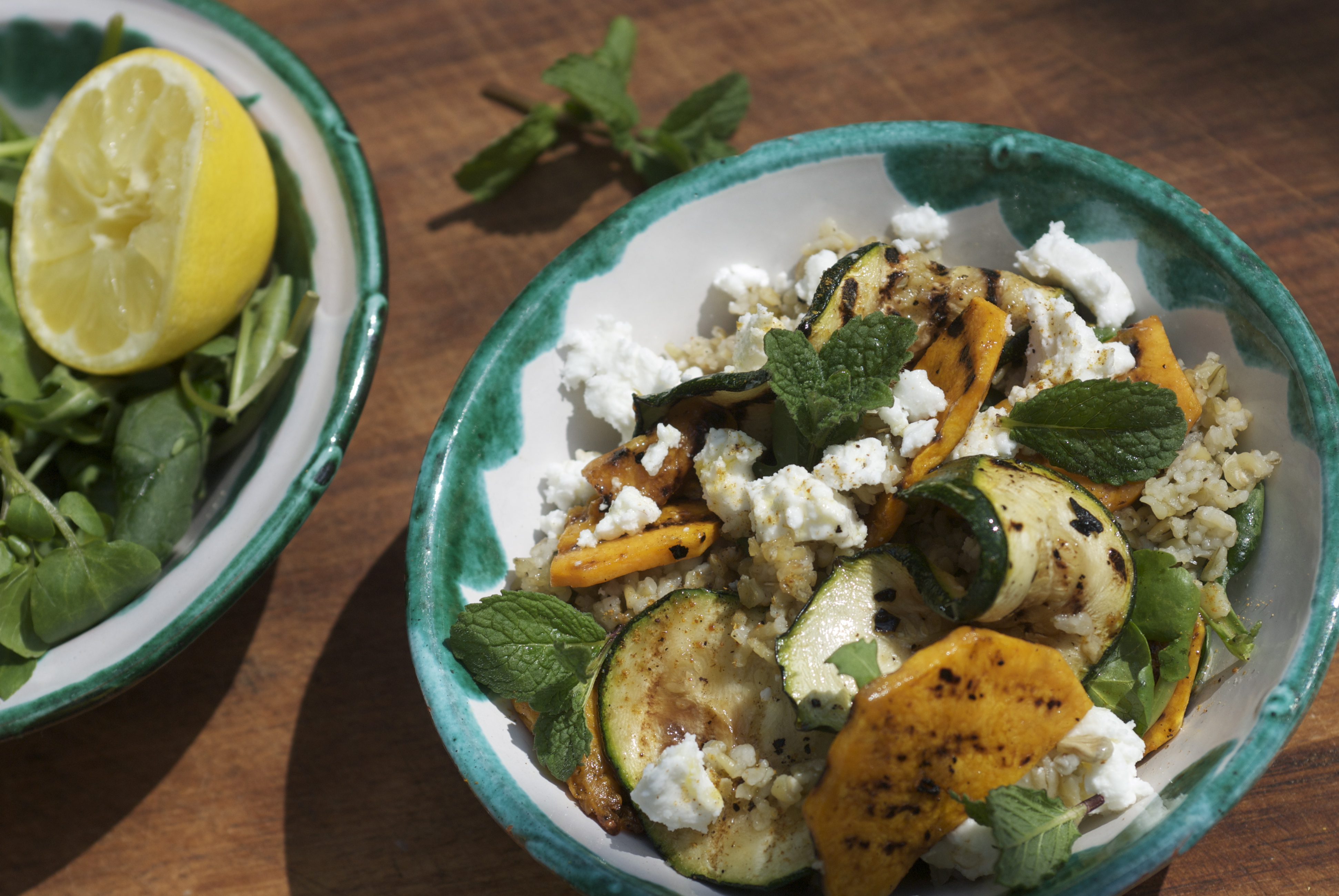
Chargrilled Courgette, Butternut and Feta salad with Freekeh
(Serves 4 as a light main)

DSC_7576

I’ve fallen back in love with the garden since Imi and I did some feverish weeding and planting yesterday. A six-year-old’s excitement and enthusiasm is just so fantastically infectious although she does seem slightly more excited about our very healthy snail population than the seedlings. Anyhow I fancied a light lunch outside and had plenty of left over freekeh (I’d definitely always cook up a double batch) in the fridge. I had a couple of courgettes and a small butternut squash from my veg box just shrieking to be eaten and so this salad was born. I devoured it as a veggie lunch but a lamb kebab straight from the barbie would turn this into a feast.

200g freekeh (cook as above) or a few spoonfuls of leftover grain from the fridge.
1/2 red onion, finely diced
3 tbsp balsamic vinegar
4 tbsp extra virgin olive oil
salt and pepper
200 g butternut squash, peeled and finely sliced
2-3 courgettes, sliced finely lengthwise
1 small hot red chilli pepper, finely diced
1/2 tsp cinnamon ( or to taste)
a good handful of mint leaves
150g feta cheese

Mix up the cooked freekeh with the onion, oil, vinegar and seasoning.

Toss the squash and courgette slice with a dash of oil, literally a dash or you’ll smoke out the kitchen. Get a ridged griddle pan really hot and sear the vegetables on both sides until nicely charred with stripes. Don’t overcook, it’s good to leave a bit of bite.

Now stir most of the vegetables along with the chilli, cinnamon and mint into the freekeh. Arrange the remaining vegetables on top and crumble over the feta.

& what to do with the rest of the packet…..

Substitute freekeh for bulghur wheat in Tabbouleh or any other Middle Eastern or Turkish style salads.
Use as a stuffing for peppers, tomatoes or even a chicken with dried fruits, nuts and seeds.

……… And Yet More Rhubarb

spiced rhubarb and grilled mackerelAt last a chance to cook up one of my favourite combinations. Lovely Kate gave me a huge pile of rhubarb from her garden a couple of days ago and the slightly milder weather has lured back the mackerel, they virtually jumped off the slab at the fishmonger’s this morning. So dinner was decided in a moment.

Grilled Mackerel with Spiced Rhubarb

I medium mackerel per person, gutted and trimmed of fins
A splash of rapeseed oil
salt and pepper

For the sauce (for 4)
2 tbsp rapeseed oil
3-4 shallots, finely diced
1 cm piece of ginger, finely diced
1-2 red chillis, finely diced (do check how hot they are)
1 star Anise
About 4 sticks of rhubarb
Juice of 1 orange
2 tbsp sugar
1-2 tbsp Tamari or Soy Sauce

Pre-heat the oven or grill to its highest setting. Line your tray with a bit of foil, to save on washing up later, & then splash on the oil. Turn the fish in the oil and then season. Set the fish aside whilst you get the sauce done.

This sauce is a cinch.  Just fry the shallot, ginger, chilli and star anise for about 10 minutes until slightly golden and very fragrant. Add the rhubarb, orange juice, sugar and a splash of Tamari. Simmer gently until the rhubarb is soft but still intact. If you do have a disaster and the rhubarb collapses into a stringy mess then it’s best to puree the sauce completely. Balance the sauce with more sugar or Tamari if necessary.

Cook the mackerel in the oven or under the grill until just cooked through and coming away from the bone. We had new potatoes and a fresh green salad with ours this evening. Very, very nice indeed.

The sauce is also stunning with pork belly and I’m up for trying it with roast duck next time around.

Rhubarb Cordial

I still had mounds of rhubarb and decided to make some cordial. I wasn’t expecting the fabulous girly-pink juice that I’ve seen in magazines since most of the sticks were rather green (and no Kate, I am NOT complaining). But, I have to admit to being pretty chuffed with the stunning peachy-pink of my cordial, which is good news since I think that boiling up the expensive, early forced rhubarb really would be too much of an extravagance.

I’ve tinkered with my recipe a little because the cordial could do with being a a bit more intense. It really only worked at a 50/50 dilution so I’ve cut down on the water in my recipe below. So yours could come out an even more amazing colour.

rhubarb cordialAbout 500g rhubarb, chopped into smallish logs
Juice of 2 orange
Juice of 1/2 a lemon
200 g raw castor sugar
200 ml water

Fling everything in the pan and simmer until the rhubarb has just collapsed and looks rather slimy and revolting.

Strain the rhubarb mixture through a sieve and resist from stirring, prodding and squashing (or you will end up with a cloudy syrup). The cordial will drip through slowly. You could leave it to strain in the fridge overnight if you have room. I never do, my fridge is a nightmare; an avalanche just waiting to happen.

Bottle the cordial, keep in the fridge and use within a week. If you really do have a massive rhubarb crop on your hands you could stir in about a tablespoon of citric acid (available from shops that sell home-brewing kit) to the rhubarb just before straining  and then you’ll be able to keep it for months. It’s delicious with some stem ginger syrup added too.

Try your cordial with:

Fizzy water and fresh mint. With Prosecco, an English spin on the Harry’s Bar Bellini. With a shot of vanilla vodka (recipe to come at a later date) Or make a jelly…see below

And the leftover rhubarb mush

The rather unattractive sludge left in your sieve is fantastic stirred into some Greek yoghurt for breakfast. You could even layer it in a glass with some cream/custard and crumbled ginger nuts for a simple supper dessert.

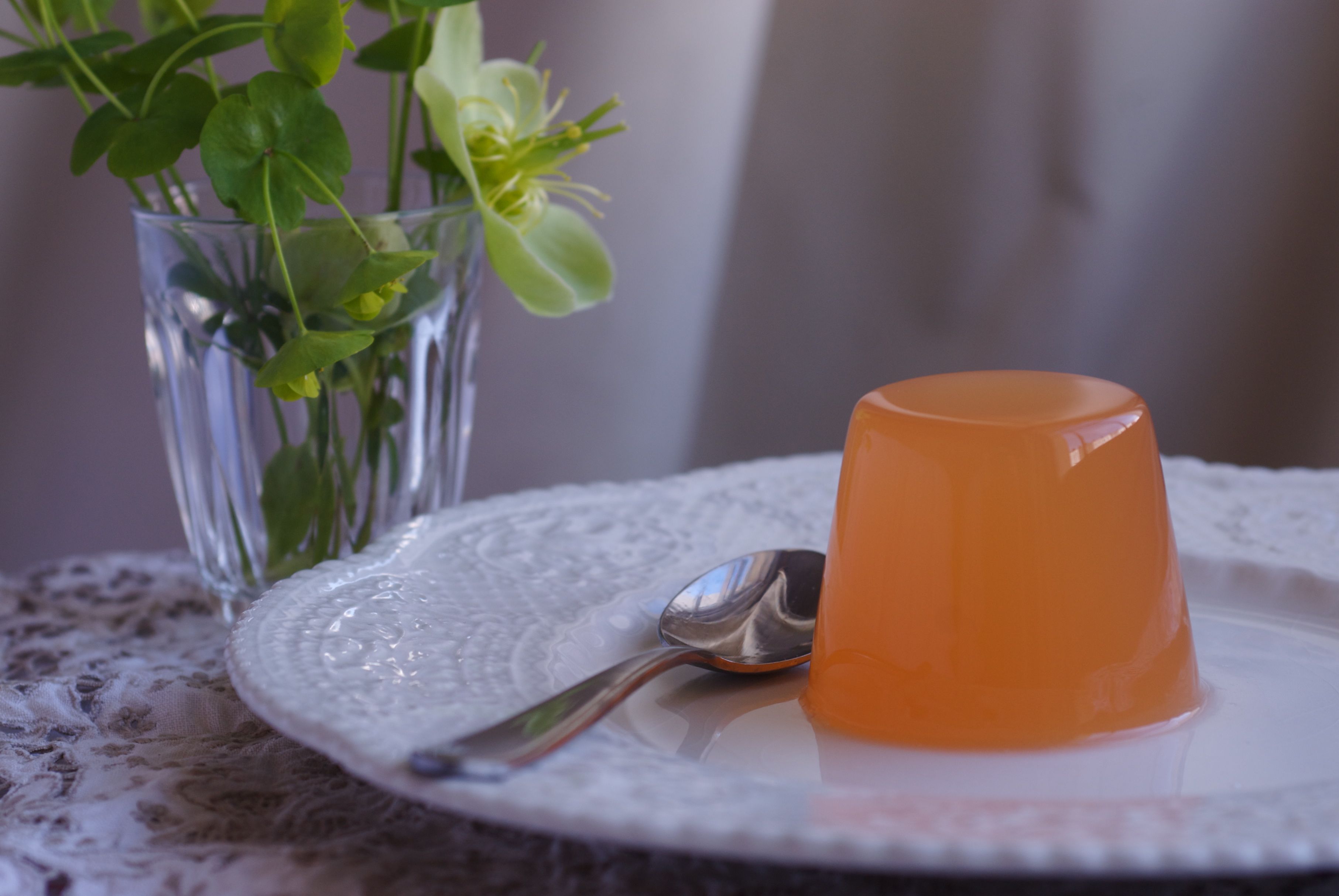
Rhubarb Jelly

Rhubarb Jelly is fabulous using your cordial. Check the size of your dariole moulds, rabbit, racing car, other jelly moulds or perhaps you’re just using glasses. Fill up the mould with water and tip into your measuring jug and multiply by however many you’re making. Take enough sheets of gelatine to set said amount of liquid and place them in a bowl of cold water to soak.

Remember not to dilute the cordial too much, your jelly needs to be much sweeter and stronger tasting than a drink would be. Heat up about 1/4 of your diluted cordial. Remove the floppy sheets of gelatine from their water, give them a squeeze and then add to the hot liquid. They’ll dissolve in an instant. Add the remaining liquid for your jelly and tip into the moulds. Leave for a few hours to set.

Dip the jelly moulds into some hot water, just for as few seconds, and turn out onto plates.

rhubarb jelly

Rhubarb, Rhubarb

Rhubarb

I can’t help muttering “rhubarb, rhubarb” every time I decide to cook some. It’s rather like shrieking “Basoool” in a Sybil Fawlty-esque voice whenever I make some pesto. It’s really not funny but there are certain bits of ridiculous British humour that have become lodged in my brain for life. I’ve not seen the Eric Sykes film Rhubarb, Rhubarb for decades. I’m not even sure that a farcical game of golf between a policeman and a vicar (whose only words “rhubarb, rhubarb” are repeated many, many times) would be that amusing any more, but now I’m determined to track the film down just to see.

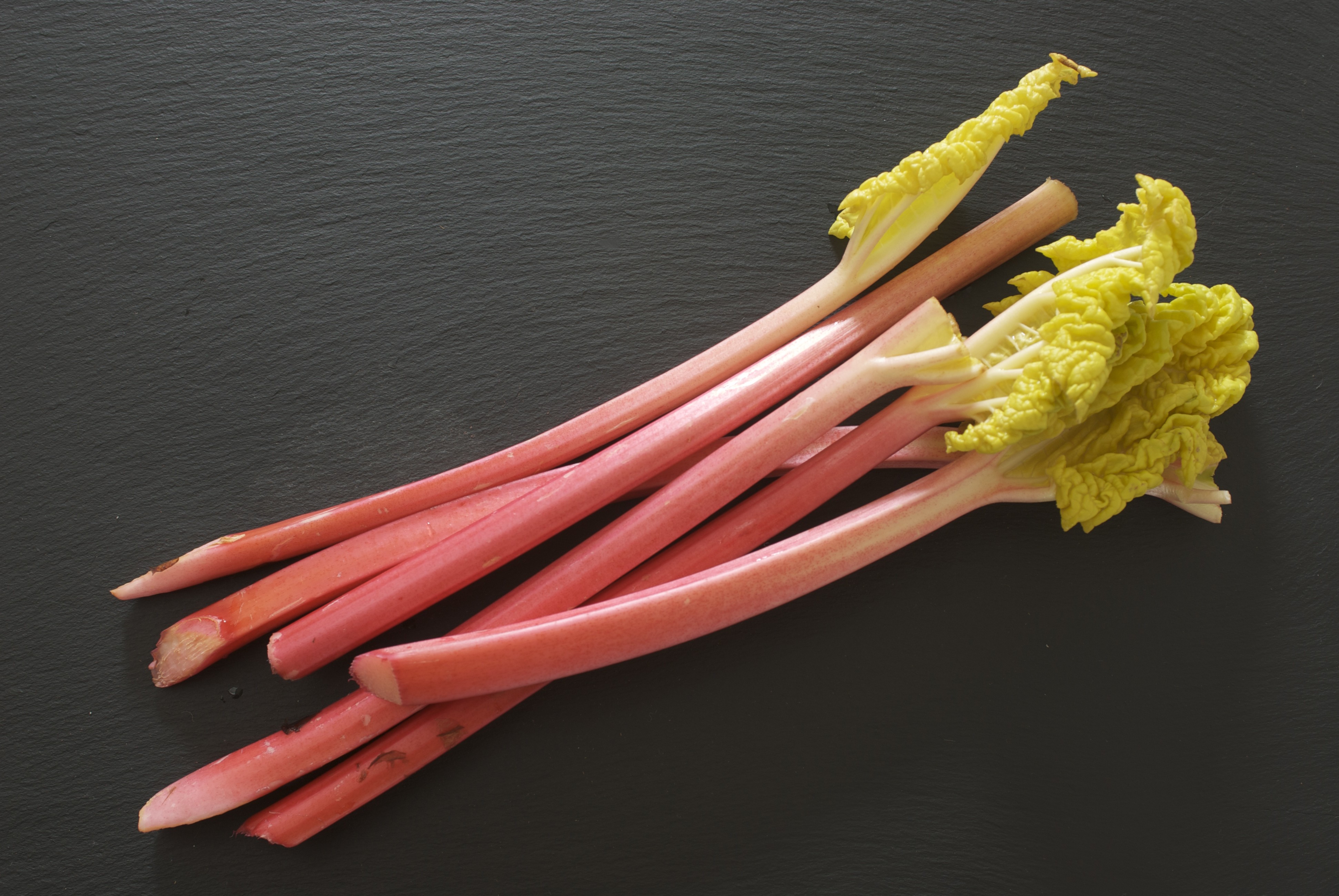
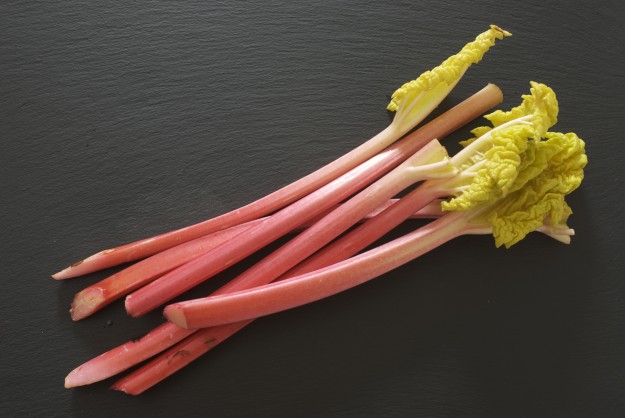
I’m especially in love with rhubarb at this time of year when the stalks are still slender, tender and lurid pink. I loathed it as a child. It was the school pudding that did it;  slimy mush topped with undercooked pastry, all floating in a pool of lumpy Bird’s custard. Now I just can’t get enough of the stuff whether it’s the stunning Barbie-pink forced stems or the more sturdy garden varieties.

So, I had my big bunch of rhubarb and had already decided that the finer pieces would end up on top of a gingery meringue whilst I made a zippy sauce with the stumpier pieces to go with some wonderful fresh mackerel. Disaster, no mackerel. We’re not the only ones who are throughly peed off with the shockingly cold spring. The freezing easterly winds have sent the mackerel in the English Channel packing, seeking refuge in deeper waters, and only some milder westerly weather will bring them back. Thankfully David Smith, my fantastic fishmonger, does stock some delicious smoked mackerel from the local Severn and Wye Smokery too.

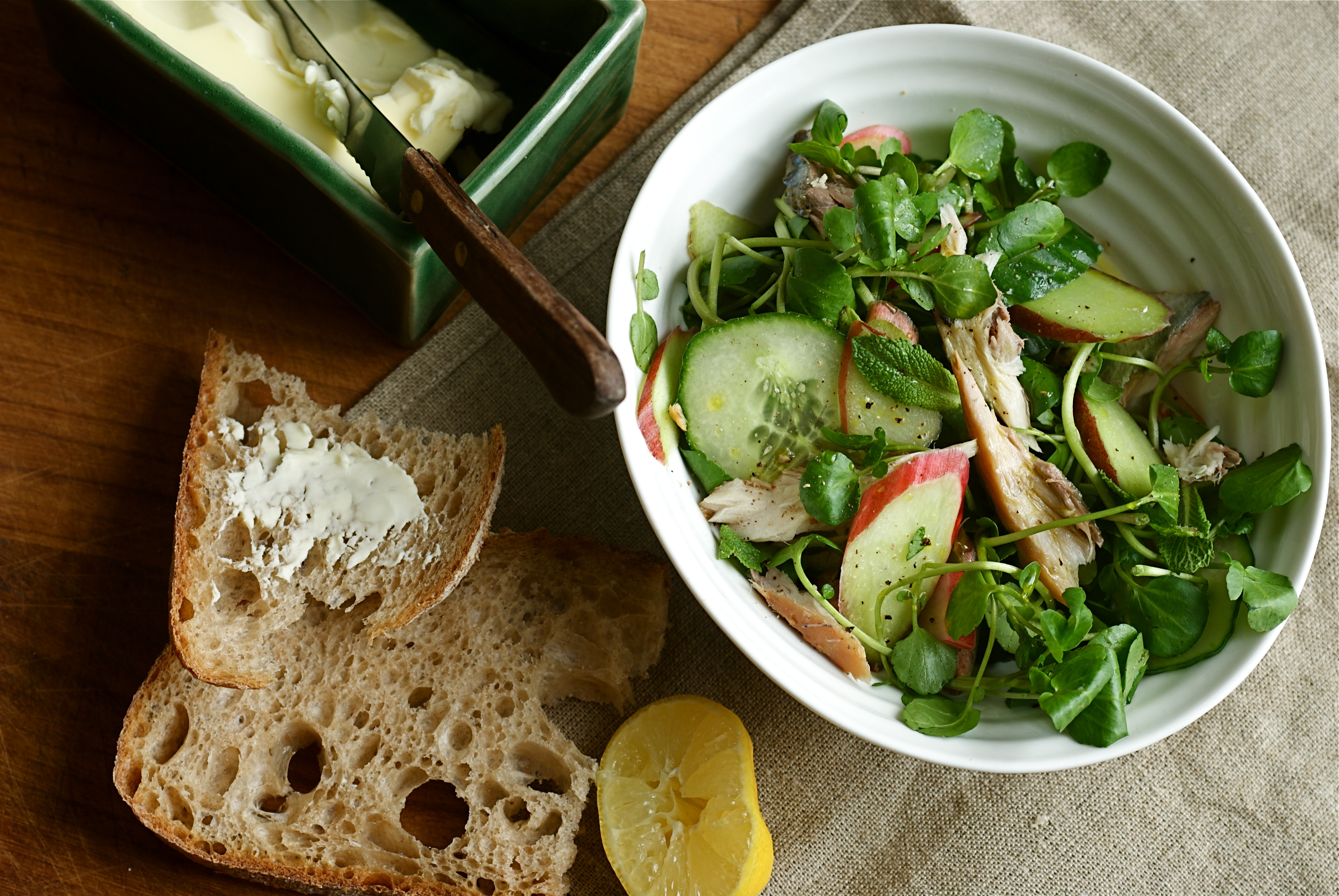
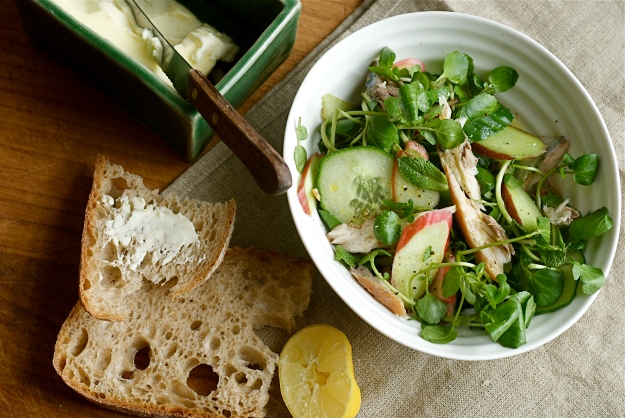
I changed tack and decided to try a dish using raw rhubarb. A Dutch friend had told me that he used to munch at the stems dipped in sugar when he was little. I tried it today. Not bad but rather like the super-sour sweets that children pretend to relish. I’m sure that they’re the junior equivalent of the posturing male’s Vindaloo curry, managing to look like you enjoy them brings some bizarre form of kudos amongst peers. I was more up for trying the traditional Iranian salad of salted rhubarb and cucumber that I’d found in Paula Wolfert’s brilliant book The Slow Mediterranean Kitchen. The tart, fresh crunch was a great combination with the rich oily fish. I swapped watercress for the rocket, did add a pinch of sugar, a splash of rapeseed oil and of course the smoked mackerel.
rhubarb and mackerel salad

Smoked Mackerel and Raw Rhubarb Salad

Serves 4 as a starter or 2 as a light lunch

2-3 stalks of rhubarb
1 small or 1/2 a large cucumber
2 tbsp salt
1 large bunch of watercress
2 fillets of smoked mackerel, skin removed
Juice of 1/2 a lemon
2 tbsp rapeseed oil
Black pepper and a pinch of sugar

Slice the rhubarb and the cucumber as thinly as possible (mandolin or knife, that’s your choice). I’d only bother to peel the cucumber if I was using one of the delicious, but tougher skinned, continental varieties & maybe thicker garden rhubarb would be best peeled too.

Put the rhubarb and cucumber in a colander and toss with the salt. Leave for 10 minutes and then rinse and drain it.

Now throw the salad together in a bowl, shredding the mackerel flesh in with the rhubarb, cucumber and watercress. Add the mint, lemon juice, rapeseed oil and pepper. Balance up the flavours with a pinch of sugar or salt, or maybe both.

Delicious with some sourdough bread and plenty of butter.
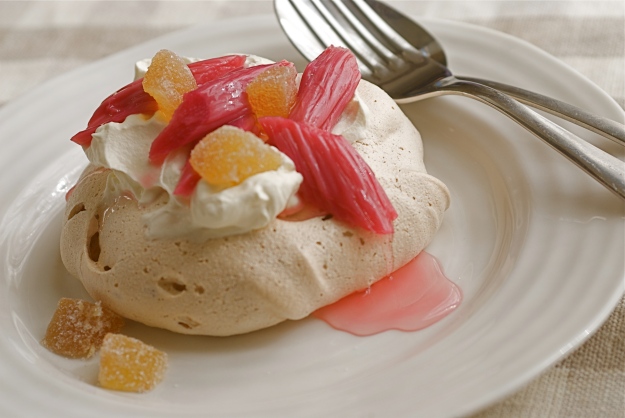
rhubarb and ginger pavlova


Mini Rhubarb and Ginger Pavlovas

The rather decadent mini pavlovas went ahead as planned. The classic combination of rhubarb and ginger is heaven. I really did pile the dried ginger into the meringue mixture, as well as serving some little chunks of the fiery crystalised stuff on the top. The pinky, pink rhubarb really looks beautiful. Save fools and crumbles for later in the season when it’s lost its good looks but still tastes great.

Serves 4 (with 4-6 left over meringues for another day – keep in a sealed bag/box/tin)

4 medium egg whites
225 g caster sugar
1 1/2 tsp ground ginger
1 tsp vanilla extract
1 tsp white wine vinegar
1 tsp cornflour

For the top
3-4 sticks of rhubarb, cut into 5cm-ish pieces
150 ml double cream, whipped until just stiff
8 pieces of crystalized ginger, sliced

Pre heat the oven to 180c. And line 2 baking sheets with baking paper.

Take an oven proof dish and place the rhubarb in 1 layer, sprinkle over the sugar and then cover with foil. Cook in the oven for anything between about 8 and 15 minutes until just tender (timings will depend on the thickness of the stalks). Watch it like a hawk as it can turn into a rather messy looking mush if you leave it just a couple of minutes too long. Set aside to cool.

Now for the meringue. Whisk up the egg whites until stiff and then whisk in the sugar a few tablespoons at a time until the meringue is really firm and glossy. Add the ginger, vanilla, vinegar and cornflour and whisk those in too.

Use a small blob of the meringue underneath the paper to stick it to the tray. Divide the meringue into 8 or 10 circles, leaving some space in between them as they will expand a little. Flatten the meringues, making a bit of a dip in the centre.

Place the trays in the oven and turn the heat down to 120 c. Bake for about an hour until crisp and golden.  Cool.

Serve the pavlovas piled with double cream, the fabulously pink rhubarb and a few pieces of chewy ginger.

Other Ways with Rhubarb

You’ll have to hold out for the rhubarb sauce (the one for the fresh mackerel) as my friend Kate   has promised me some stems from her garden this week so I’ll post about that recipe if the Mackerel have been lured back by the warmer weekend (although it was hardly balmy).

Rhubarb coulis. Cook up thicker rhubarb in a saucepan with a couple of oranges (juice and zest) and good dose of sugar. Once tender, puree with hand held blender until smooth. Try adding a few strawberries or better still raspberries for extra flavour and colour later in the season. Fabulous with vanilla ice cream and you crumble over some Ginger Nut biscuits for a bit of crunch.

And of course there’s fool, there’s crumble, there’s pie. There’s another post waiting to happen.

Fiery Spaghetti with Purple Sprouting

sprouting in colander

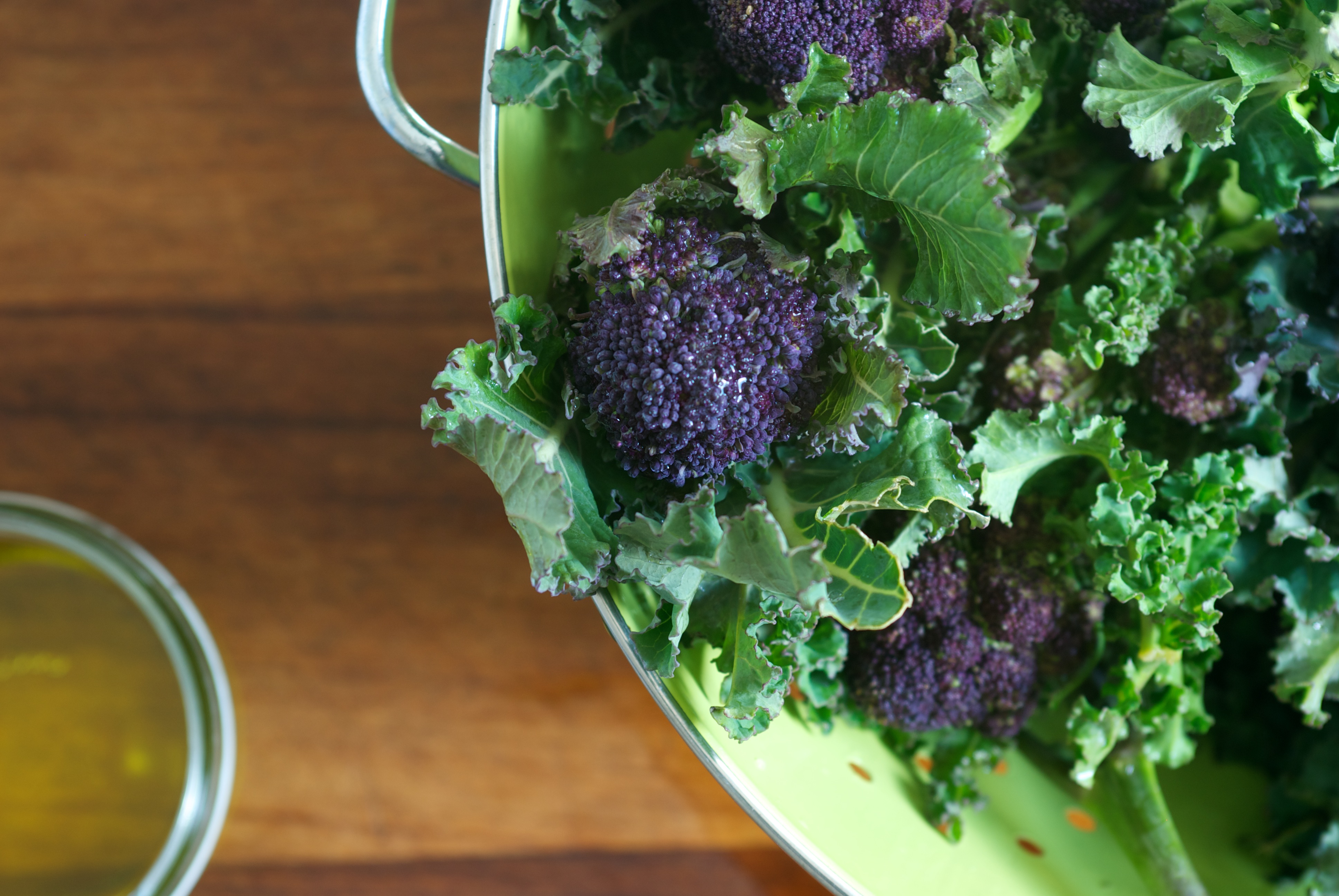
The first veg box has arrived. I’ve been umming and ahing for years about getting one. It’s just that I always plan to scour farmer’s markets and local shops for my seasonal produce, but have finally faced up to the fact that I usually end up in the supermarket. I’ll still pop up the road to the fabulous Reg the Veg for extra bits and pieces but from now on it’s the surprise element of my weekly box that will dictate what I cook (and sometimes write about).

So, amongst all the other fabulous veggies, this week’s highlight –  purple sprouting.  I love the stuff, it’s so much tastier than the green Calabrese broccoli they sell everywhere month in month out. It seems mad that a few decades ago purple sprouting broccoli was the British norm and the Italian import was considered rather exotic.

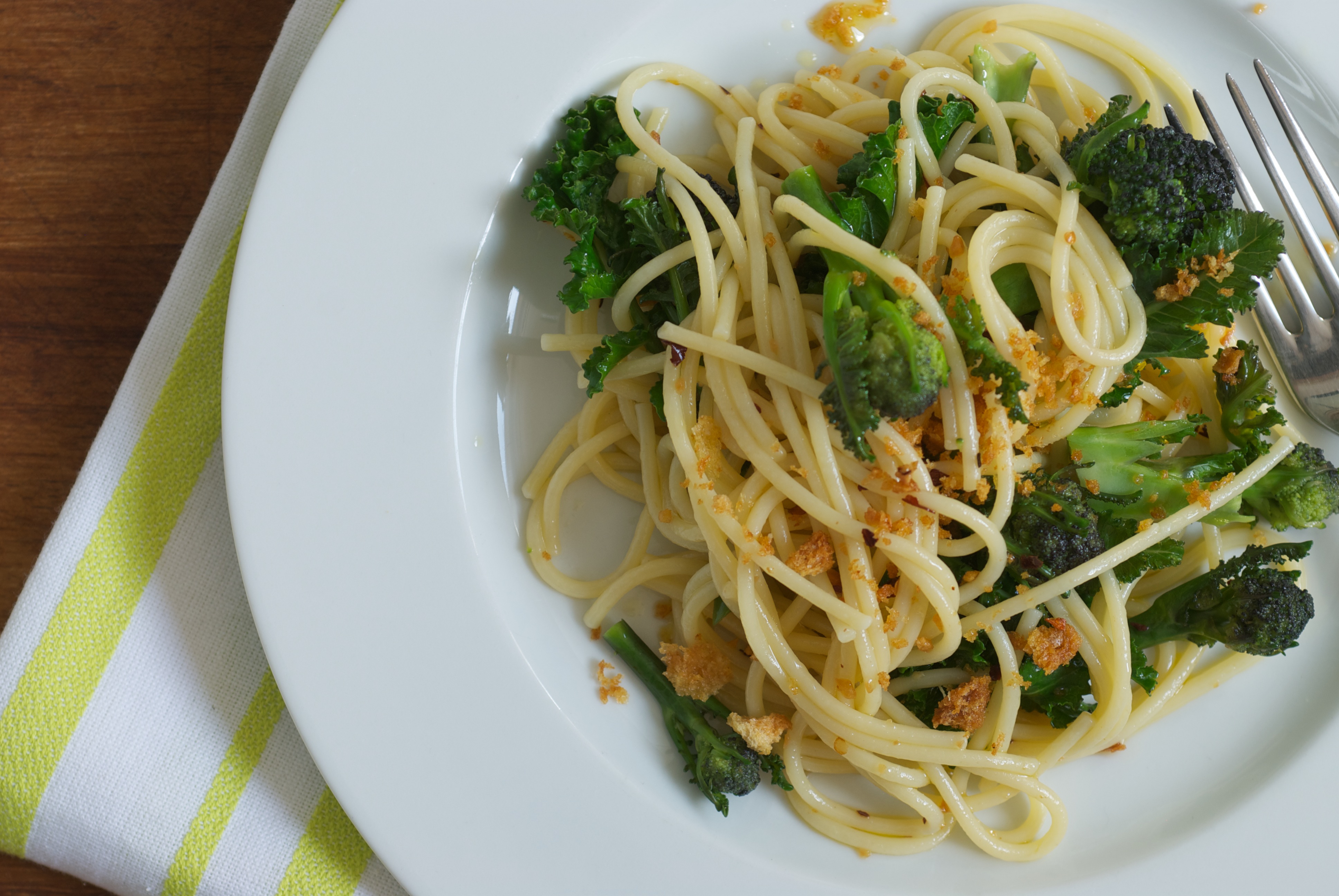
The sun shone today, it actually felt like we might be leaving the sub zero weather behind at last and so I got over excited and cooked up a rather summery feeling dish. I wanted my sprouting to play centre stage and so I opted for pasta. Italians love to cook broccoli and cauliflower with chilli and garlic, and perhaps it was the sunshine that had me feeling nostalgic about summer holidays and fiery bowls of spaghetti alio e olio. Spaghetti with oil, lashings of garlic and a good dose of chilli is about as cheap and basic as a bowl of pasta can get, but I became addicted on last year’s holiday in Calabria. (Highlights: the stunning old town of Tropea, the Aeolian islands and amazing food all round. Low point: JoJo getting a jelly fish stuck down his swimming trunks.)

But, back to the pasta. You could add all sorts of other bits to this dish such as toasted pine kernels, capers, salted anchovies or sun blush tomatoes (the juicy semi-dried ones) but I love its simplicity. You really don’t need parmesan, the crispy breadcrumbs are often referred to as poor man’s parmesan in any case. And, if pasta’s not your thing then just try this dish with butter beans instead.

Fiery Spaghetti with Purple Sprouting

Sprouting pasta and fork

300 g purple sprouting
A large handful of fresh bread crumbs along with 2 tbsp olive oil
3-4 cloves of garlic, very finely chopped
1/2 tsp dried chilli flakes, or a couple of dried chillis finely chopped
About 250 ml extra virgin olive oil

Trim any tough stalks from the sprouting (the guinea pigs are in heaven) but keep all those delicious leaves. Give it a rinse.

Toss the breadcrumbs around in the olive oil and roast on a tray for around 10 minutes in a hot oven (200c ish) until throughly crisp and golden. You can toast up a double quantity and keep some in a jar for a few days too (they add a good bit of crunch to a salad)

Throw the garlic and chilli into a small pan with the cold extra virgin oil and heat through really slowly so that the garlic flavour infuses the oil. Whip it off the heat as soon as the garlic begins to colour, it will continue to cook for a minute or two. You want to finish up with glorious gold rather than burnt brown. Set the oil aside (do it ahead if you feel like it).

Cook the pasta in plenty of salted boiling water until al dente and steam or boil the sprouting for a matter of minutes until just tender. (I have a steamer that fits perfectly on top of my pasta pan.)

Now it’s just a question of tossing the drained pasta in the wickedly fiery garlic oil and then carefully rolling in the purple sprouting. Sprinkle over the breadcrumbs and serve.

purple sprouting and EVOOther Wonderful Ways with Purple Sprouting

Classic anchovy dressing – Pound about 6 salted anchovy fillets together with the juice of half a lemon, about 3 tablespoons of extra virgin olive oil and plenty of freshly ground black pepper. Steam or boil about 500 g of sprouting. Drain and toss in the oil. Sublime alongside lamb.

Try going down the Oriental route – Steam or boil about 500 g of sprouting until just tender and then refresh in cold water. Stir fry about a teaspoon of chopped garlic, a teaspoon of chopped ginger and a couple of finely diced chillis in a splash of vegetable oil until fabulously fragrant. Toss in a tablespoon of fermented black beans along with the sprouting, stir to heat through and serve.


Is there anybody out there?

Hello, and how the hell did you find me?

I’m so excited that, as a complete technophobe, I’m here writing my first post. It will be short. It’s almost midnight and it’s only taken me about three days to get this far (my trusty handbook  promised me that I’d be posting within six minutes) but I’m elated. I’m the woman who’s had an iPhone for years and my only app is a burping dog game downloaded by a friend in a desperate attempt to keep my six year old quiet in a restaurant. I’ll be tweeting by the end of the week too.

You’ll have to wait for another few days for something more exciting. I’m taking delivery of my first vegetable box next week and lying within will be my source of inspiration.

So for seasonal recipes, photos, a bit of chat and the odd tip….. WATCH THIS SPACE!