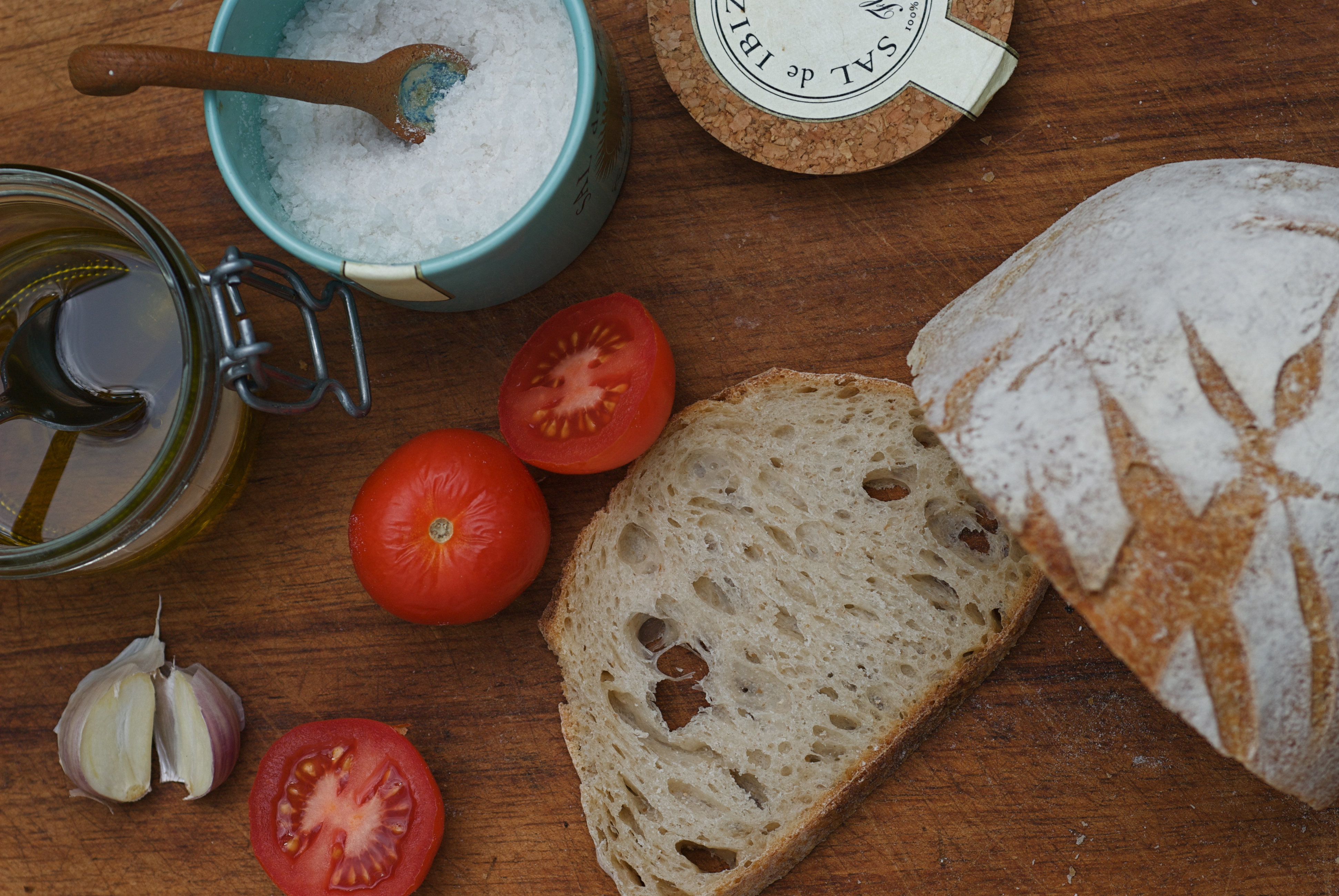
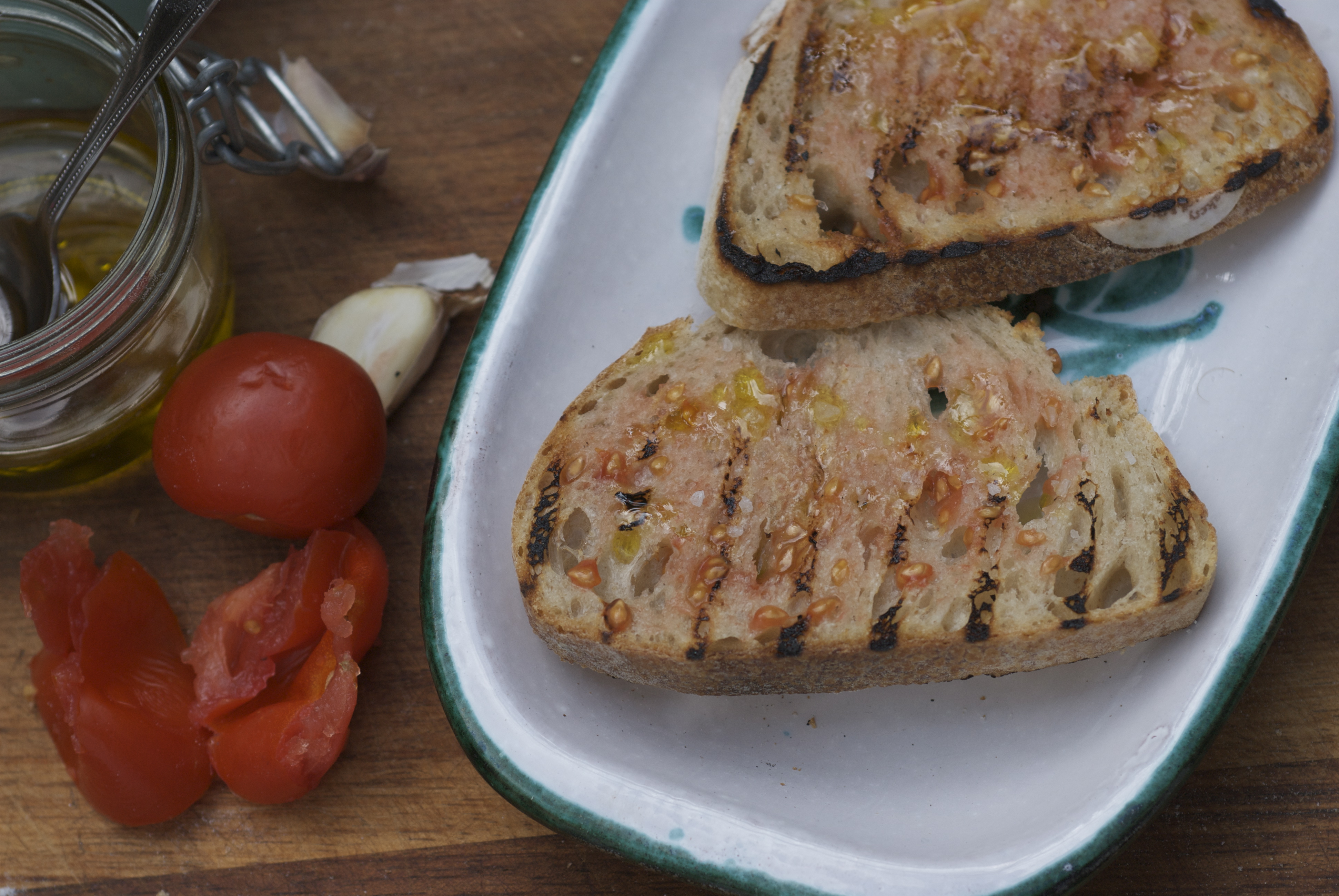
Author Archives: Jenny Chandler

Unknown's avatar

About Jenny Chandler

I am a food writer and cooking teacher

Elderflower Vinegar – Chapter Two

I finally got around to straining the elderflower vinegar that I made last month. My funnel had gone walk about and so I had ample excuse to buy a very natty lime-green, rubber snail version that I’d spotted up the road. It’s fabulous because it folds flat like a concertina and so I can wedge it into my over-filled kitchen draw. It came from a great shop, Sense in Clifton, where there’s a very tempting selection of fun, culinary gadgets. In fact my vinegar ended up being quite an extravagant affair because once I’d found my snail I couldn’t resist one or two other luminous rubber must-haves for my kitchen, but more on those at a later date.

I’ve kept my elderflowers steeping in vinegar in the fridge for the last few weeks, I probably didn’t need to but it’s been so hot lately that I worried about the flowers going mouldy. Today I strained the vinegar through muslin and put it into some old bottles I had stowed away. It tastes wonderful; really floral.Green salad with Elderflower Vinegar

I’m sure that I’ll come up with some more exciting moments to use my vinegar but today I dressed a simple green salad with Arbequina olive oil (that I simply adore), the vinegar and a bit of seasoning. We ate the aromatic salad with Cumberland sausages and new potatoes, hardly gourmet but very good all the same.
I’ll definitely be making larger quantities of the vinegar next year, and plan to begin collecting up any attractive bottles in the meantime.

Browned Butter and Cherry Muffins

I had my cherry mountain last week and, as always seems to be the case with any glut, very little time to cook them. We were off to spend the weekend camping at WOMAD so my recipe had to be both fast and transportable. What could be better than a batch of muffins? Jen's cherries

Caramelising the butter for these muffins really is the cherry on the cake. In fact browned butter, or beurre noisette as it’s known in France, is one of the simplest and most delicious things that you can whip up in the kitchen. So good in fact that I’m going to give you a fool-proof, step by step recipe.

Browned Butter- Beurre Noisette
Take a knob, or your desired weight, of unsalted butter and place it in a stainless steel pan. I like to be able to see the colour of the butter and a dark non-stick lining makes this impossible.
Now heat up the butter. The white milk solids that separate away from the fat will eventually caramelise and turn a deep bronze, giving the butter the most extraordinarily nutty flavour.

It’s all in the timing rather like a sugar caramel, and once you get cooking it’s time to tell the  PPI-claims-caller where to go. You need to watch and sniff, no stirring required. As it cooks, the large uneven bubbles on top of the butter will eventually transform into a Cappuccino-like foam. The hazel-nutty smell will waft from the pan and if you swirl it you’ll see tiny golden particles. Allow the specks to turn a really good, foxy-brick brown before tipping the butter into a cold jug or bowl. Pale gold and the butter will be cloying rather than nutty, too dark and it will taste burnt. It’s not tricky at all but you do need to be on the case.

& What To Do With Your Caramelised Butter
Add some capers, plenty of roughly chopped parsley and a good grind of black pepper. Eat with grilled, baked or fried white fish or seared scallops.

Throw in a few fresh sage leaves (about 5 to every 100 g of butter) when you begin heating up the butter. They will crisp beautifully as the butter caramelises. Serve with spaghetti, plenty of parmesan and black pepper. This makes a great sauce for spinach and ricotta, or pumpkin, ravioli.

Add to any baking recipes that call for melted butter for an extra dimension of flavour.

And Now Back to the MuffinsBrowned Butter Cherry Muffins

This really is a throw-together recipe. You can of course replace the cherries with other fruit, use vanilla rather than almond extract, exchange or leave out the nuts and even use white sugar rather than the Muscovado if it’s going to save a trip to the shops.
Makes 12 large muffins
Pre-heat the oven to 190C, 375F, Gas Mark 5

100 g browned butter
50 g flaked almonds
280 g plain flour
1 tbsp baking powder
1/2 tsp salt
1-2 tsp almond extract
200 g light brown muscovado sugar
1 large egg, lightly beaten
225 ml milk
150 g pitted cherries.

Make your caramelised butter and allow to cool whilst you get everything else ready.
Toast the flaked almonds in a frying pan, or in the pre-heated but watch them like a hawk.

Now sift the flour, baking powder and salt together and then stir in the almond extract,  3/4 of the sugar, the egg, milk and butter. Bring the mixture together but don’t over stir or you’ll end up with rubbery muffins.

Fold in most of the cherries and spoon the mixture into papers, a greased muffin tin or a silicone mould. Top with the remaining cherries and sprinkle with the last bit of sugar.

Bake for about 20 minutes, or until golden brown and an inserted skewer can be pulled out clean. Allow to cool on a rack and devour as soon as possible.

In Cherry Heaven

Cherries

I’m gorging on cherries, it’s such a treat. I rarely splash out on them in the shops, they cost a fortune and are often pretty disappointing too. Today’s cherries came from gorgeous Jen’s garden up the road in Clifton. I couldn’t believe my luck when she caught up with me in the school playground and invited me round to collect some. I seem to have gained a reputation for being a gannet; I’m thrilled, anyone’s glut will find a happy home here. The school gate brings many rewards: Jo’s quinces, Kate’s rhubarb, Dan’s cod (which Peter came home to find stuck in our letterbox one evening) and now a huge basket of Jen’s freshly picked cherries.

Imi and I arrived with our basket, fully expecting to be climbing ladders and putting in a bit of labour for our prize but Jen was up the tree in a millisecond and looked rather graceful and serene up there, a perfect photo opportunity. The tree was groaning with fruit, this blast of summer heat has obviously done the trick and she filled our basket in a matter of minutes. I tried to avert my gaze from the other trees laden with young apples and plums just in case I seemed to be eyeing up the next potential bumper crop, I don’t want to push my luck. One thing’s for sure, the ornamental cherry that’s just pegged it in our garden will be replaced with a fruit tree. In fact, why do we ever plant anything but fruit trees in our towns and cities? Just take a look at what Pam Warhurst has achieved with the Incredible Edible movement in Todmorden, Yorkshire, where virtually every inch of public land has been planted up with fruit and vegetables.

Now, as I dive into another cherry, I’m just weighing up what to do with the remaining kilo!
Perhaps some browned-butter and cherry muffins and then I can’t decide between a jar of pickled cherries and or a compote. First I may just go out and invest in a cherry pitter. Will it double up for olives too? I’ll let you know along with some recipes in the next few days.

  • Rent your own cherry tree (telegraph.co.uk) – What an amazing concept! A bit too far for me, but surely some of those Somerset apple orchards could follow suit?

Pretty in Pink – Candy Stripe Beetroot Salad

DSC_8170_2

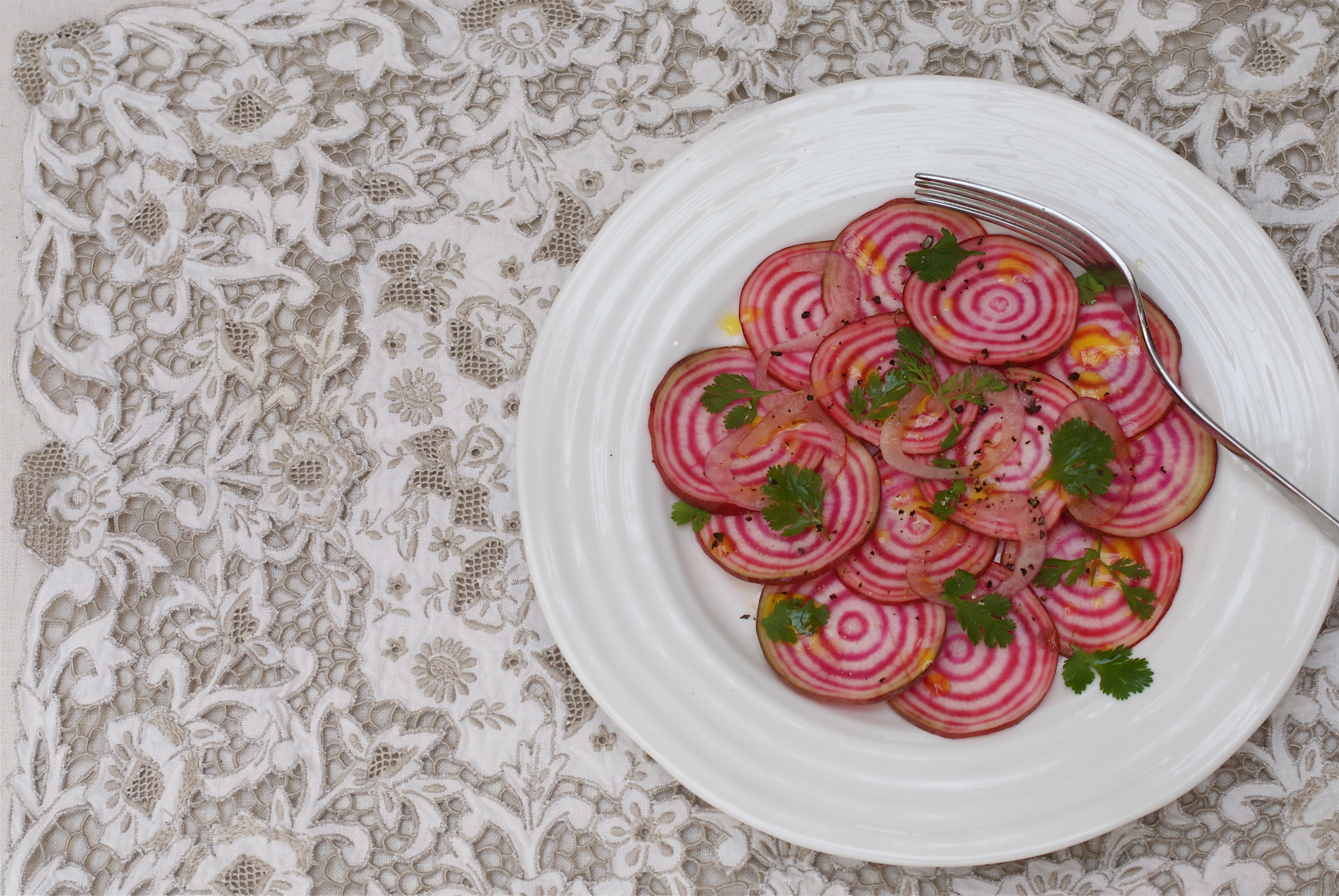
A truly Barbie-esque salad. Raw, paper-thin candy-stripe beetroot is ridiculously pretty . It reminds me of the sticks of rock we sucked at in the back of the car as children, on the way back from our annual Welsh holiday. It always seemed magical how the Abersoch lettering never disappeared and, having done a bit of research, it’s still pretty baffling how anyone dreamt up the unbelievably complicated business of inlaying a stick of sugar with the name of a beach resort.

I found my stripey beetroot in the local green grocer, Reg the Veg, you’ll often find it at farmer’s markets too. It’s sometimes known as Chioggia beetroot (yes, it comes from the same region of the Italian Veneto as another pink favourite of mine, radicchio). Sadly the stripes do disappear when you cook it, but I still love the peachy-pink colouring especially if you combine it in a dish with traditional and golden beetroot as well.

The raw salad is not my invention, there are plenty of variations on the web, but it is rather special so I thought I’d share it with you. I’d serve this as a side salad with cold chicken or ham or as a simple starter with a sprinkling of goat’s cheese and some delicious rye bread. You could slice some apples equatorially too. I may even invest in a mandolin.

DSC_8161Candy-Stripe Beetroot Salad  Serves 4

1/2 a small red onion, sliced very finely
2-3 tbsp white wine vinegar, I love moscatel vinegar
4 medium sized beetroot, washed very throughly but skin left on
2-3 tbsp cold pressed rapeseed oil
a few coriander leaves
salt and black pepper

Place the sliced onion in a small bowl and tip over the vinegar, this not only tempers the strong  flavour but also helps the onion look turn sugary pink too.

Now slice the beetroot as wafer thin as you can, a mandoline is the ideal tool but a very sharp knife and plenty of patience will do just fine.

Lay the beetroot slices out on a platter. Sprinkle over the onion and the vinegar. Drizzle over the rapeseed oil, toss on the coriander and season well.

Chickpea, Egg and Potato salad with Salsa Verde

It’s been so hot over the last few days that I’ve had to rig up a sunshade over the guinea-pig hutch and seem to spend my life watering the tomatoes. I usually become mildly panicked when it’s sunny, incase I miss any opportunity to be outside, but now I’m relaxing into the seemingly endless warmth. Lunch in the garden feels almost normal and I’m rediscovering lots of great salads.

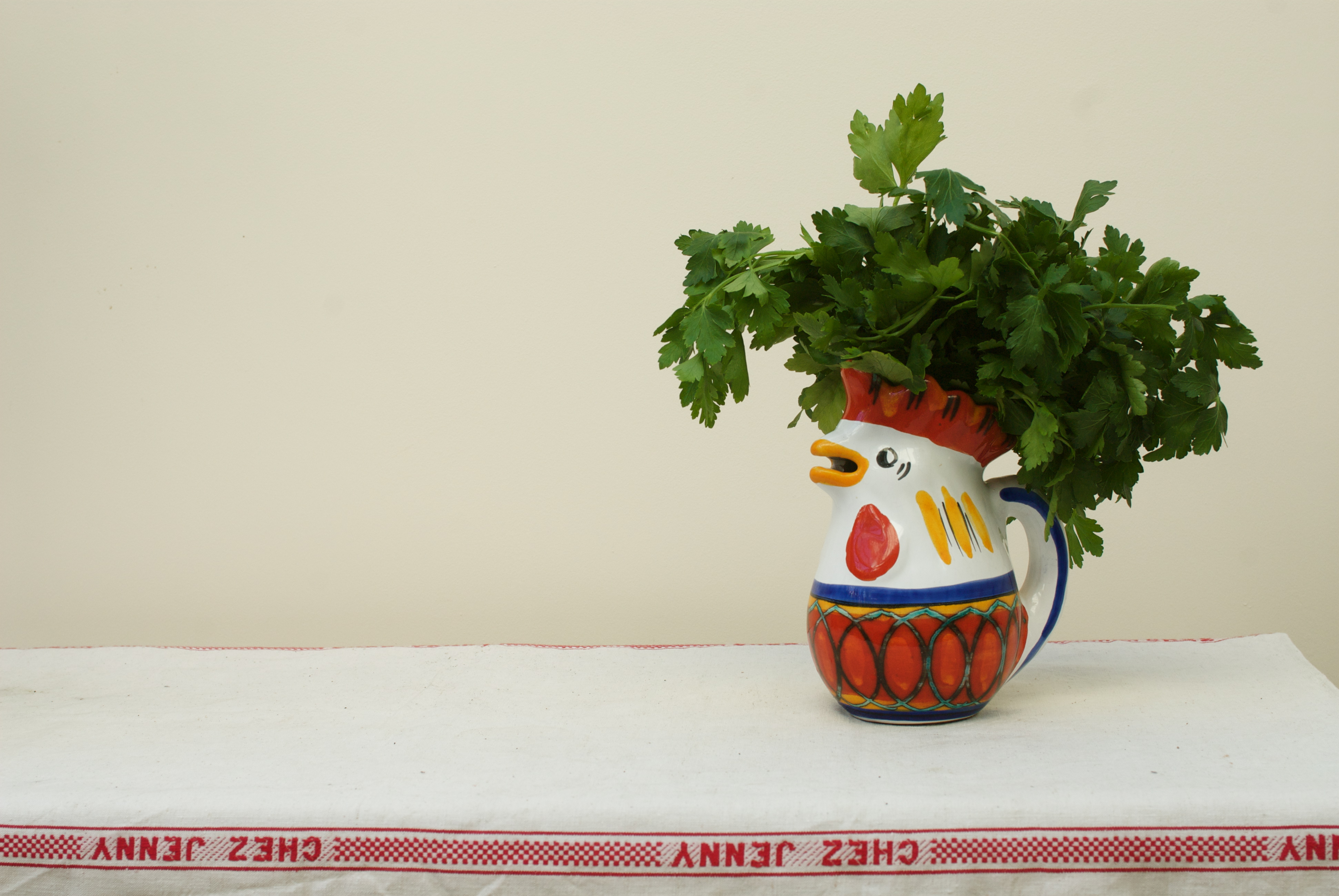
Parsley may not be as punchy as coriander, mint or basil but I love its summery freshness and there’s nothing like a good bunch to spruce up my Calabrian cockerel. I do try to reign myself in and stick to white china, so much better for photography, but can’t resist a bit of gaudy kitsch when it comes along.

Calabrian Cockerel with Parsley

But back to the parsley. I abandoned the curly English stuff years ago, you have to chop it so finely (otherwise it’s like eating sawdust) that it becomes a faff. Childhood memories of the rather gloopy parsley sauce that always accompanied the home-cooked ham, and the ever present garnish on the pub plate, didn’t hold much promise either. It wasn’t until I experienced Mediterranean ways with parsley such as Middle Eastern tabbouleh, the Spanish picada  or Italian salsa verde that I was really smitten.

Salsa verde is loaded with fresh parsley, salty anchovies, feisty garlic, acidic lemon juice or vinegar, slightly bitter capers, pungent mustard and rich extra virgin olive oil. It’s the perfect balance of piquancy, leafiness and oily richness that breathes new life into simple ingredients such as my chickpea and potato salad. Salsa verde is traditionally eaten with bollito misto (boiled meats) but it’s good with roast lamb, salmon and with the crispy, parmesan-fried chicken that I’ll have to share with you at a later date.

Salsa Verde

A large handful of parsley, roughly chopped
2 ½  tablespoons of capers
6 anchovy fillets, chopped
2 cloves garlic, finely chopped
1 tsp Dijon mustard
2 tbs of red wine vinegar or 1 tablespoon of lemon juice
6-8 tbs of extra virgin olive oil
salt and black pepper

Throw all the ingredients into a food processor and pulse until you have a rough pesto consistency. Now taste and balance with more salty anchovy, oil or acidity as necessary.

I sometimes play around with the herbs in the sauce by adding a little basil, mint, chives or rosemary but always keep the parsley as the main player. You can, of course, just leave out the anchovy for a veggie version and add a bit of extra salt.

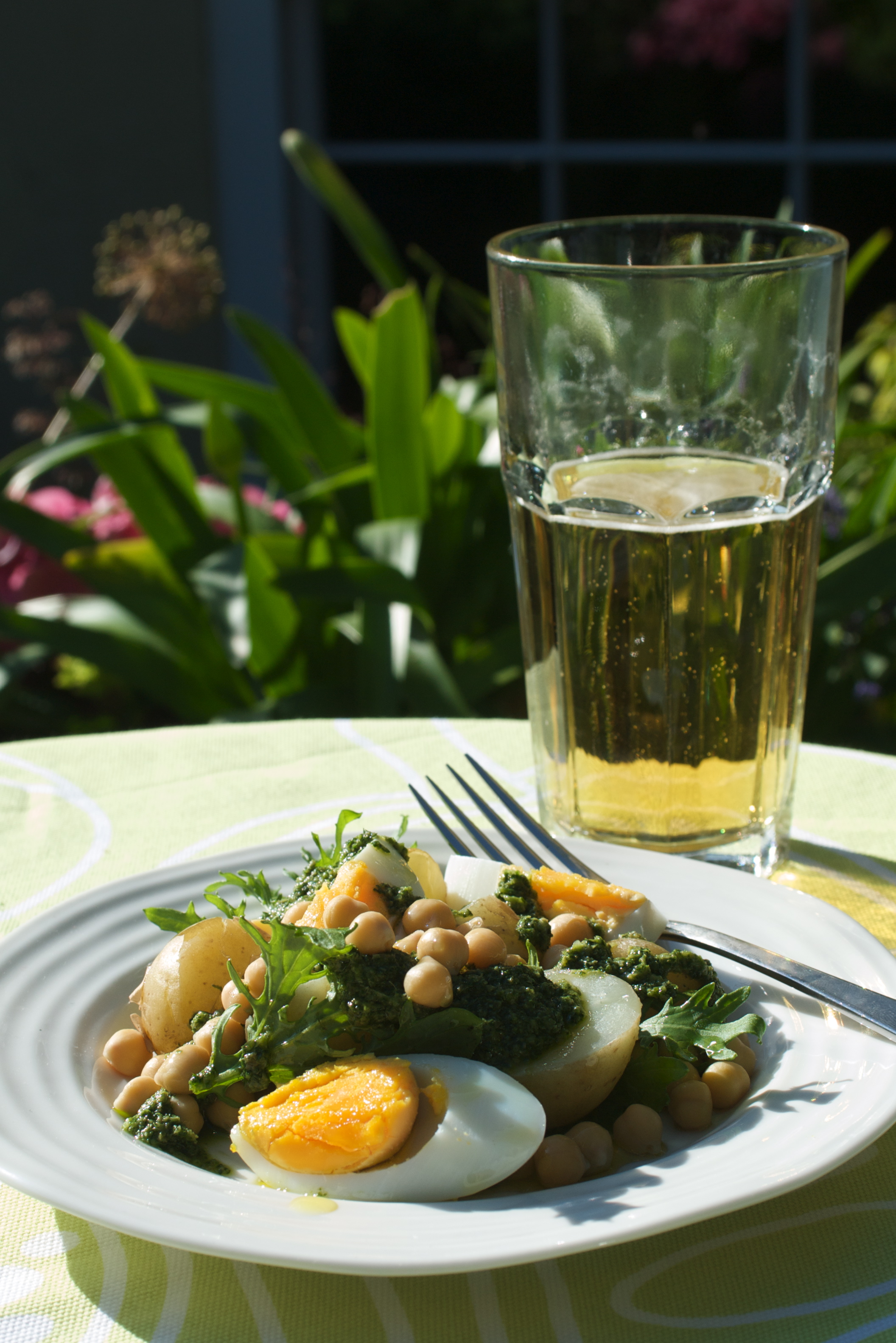
Chicpea, potato and egg salad with Salsa VerdeChickpea, Egg and Potato Salad with Salsa Verde

The salsa verde’s punchy flavours really give this salad some punch. I adore the potato/chickpea combination. It’s worth splashing out on a good salad potato- the knobbly Pink Fir Apple, the nutty Anya and, of course, Jersey Royals when they’re around.
Serves 4 as a main, 6 as a side

350 g/ 12 oz small waxy potatoes
500 g/ 1lb 2 oz home cooked or 2 x 400 g /14 oz tins of chickpeas, drained
100 g tender, green salad such as lamb’s lettuce or spinach
2 tbsp extra virgin olive oil
4 eggs, hard boiled (7-8 minutes on a rolling boil will give you a just-set egg yolk)
1 x Salsa Verde recipe

Boil the potatoes in salted water until tender, drain and place in a large serving bowl with the chickpeas.
Add the salad leaves keeping about a dozen for garnish. Stir through the olive oil to coat.
Spoon over the Salsa Verde, allowing the potatoes and chickpeas to peep through in places.
Peel and quarter the eggs and lay over the top of the salad with the remaining leaves.


Elderflower Vinegar

What a weekend, who’d have believed it?  Summer’s arrived at last, Murray’s won Wimbledon and we finally got around to picking some elderflower blossom. Rather than making some cordial I plumped for vinegar this year; I may even christen my finished bottle with some suitably corny, Murry-esque title if I can think of one (all suggestions welcome).

I’ve been eyeing up the bounteous blossom for weeks. Has it been a particularly good year or is it just the fact that I’ve been frustrated at never getting out there ? Well, what with the sudden heat-wave I really did think that I might have missed the boat, as the flowers must be fresh and new or there’s the chance of that rather nasty cat-pee bouquet. We finally made our way up to The Downs, Bristol’s fabulous open park land, to find the place heaving with cars and runners and so we were forced to retreat to one lone elder we’d spotted on the way.

We perched precariously on our steps, reaching out with the loppers over a very uninviting bed of nettles and managed a rather measly pile of flowers. So, gallons of cordial were obviously out of the question and suddenly Diana Henry’s suggestion of Elderflower vinegar (from her fabulous book salt sugar smoke) seemed perfect. It’s a cinch to make too.

Elderflower Vinegar

1 suitable  jar, such as a kilner jar, sterilised
Enough elderflower heads to fill your jar
1 bottle of white wine vinegar.

Clean off the blossom, shaking off any bugs, but don’t wash it or you’ll lose all the fragrant pollen (don’t pick after a dewy dawn or rain either, for the very same reason).

Push the flower heads into the jar and cover with vinegar. I put a plastic pastry cutter in on top of the flowers to keep them below the surface of the vinegar. Leave for 3 weeks in a cool, dark place and then strain through muslin.

I couldn’t resist a little taste today and amazingly the vinegar has already taken on some fabulous floral notes. I’ll update you in a few weeks time.

Elderflower Jelly

It’s always good to have a few cheat’s recipes up your sleeve just in case you’re really short of time. Obviously a jelly does take a few hours to set but when it comes to the actual preparation time it’s just a matter of minutes, especially if you take a short cut and use bought cordial.
Elderflower Jelly
I should really be ashamed to be using commercial elderflower cordial when, with the blossom at its prime, every self-respecting food blogger is writing about their own home-bottled stuff but hey, this is meant to be a minimum effort/maximum impact pud. And, there’s nothing to stop you using your own cordial if you like ( I’m peed off as I was planning to harvest some blossom today, a bit late I know, and now it’s rained washing away all the fragrance).

Jellies are very “in” at the moment, just take a look at the feats of the fabulously eccentric partnership Bompas and Parr. Our fascination with jelly is nothing new, the Victorians created some  extraordinarily fancy jellies. My take on these fabulous puddings is much simpler, but certainly a step above the Mr Chivers variety, that I have to admit, I loved as a child (especially if I managed to sneak a couple of the rubbery squares of super-sweet gelatin straight from the box).

The beauty of using elderflower, or any other clear liquid, is that the fruit or flowers are magnified, and once turned out the jelly looks rather like those paper weights people used to have with dandelion clocks or scorpions lurking inside. Back in the ’70’s my sister and I created dozens of these very attractive ornaments for relatives with a wondrous kit called Plasticraft (I’m sure it must have been banned, glue sniffing would probably have been safer, the noxious fumes left you light headed for hours). Now back to the jelly; the secret is to build it in layers as the berries or flowers will always float to the surface of the liquid so if you fling it all in at once you don’t get the fabulous suspended look.

Leaf gelatine is a wonder ingredient, it makes creating a jelly an absolute doddle. I do use a little less gelatin than the manufacturers advise, there’s nothing worse than rubbery jelly, so I tend to down it by about a 1/4. If in doubt start with setting your jellies in glasses and move on to turning out once you’ve cracked it. There are vegetarian jelly crystals out there too, but I’ve never been quite so excited about the texture.

Elderflower Jelly with Blueberries and Borage flowers

Serves 6
Elderflower cordial (bought or home -made)
Leaf gelatine
200 g blueberries
18 borage flowers

Check the capacity of your moulds or glasses. I love the Basque wine/cider glasses I’ve used in the picture but you might use little metal timbale or dariole moulds and turn the jelly out. I needed 1.2 litres of liquid in total.

Now make up that quantity of an intense dilution of your cordial, rather sweeter and stronger than you would drink.

Calculate how many sheets of gelatine you require. I’m not giving you the quantities here as different brands seem to have different size leaves (and I always reduce the gelatin to liquid ratio a little). Put your sheets of gelatin into a bowl of cold water to soften.

Meanwhile heat up about 200 ml of the cordial mixture, or enough to melt the gelatin in. Squeeze the excess water from the rubbery sheets and add them to the very hot (but not boiling liquid) Stir the liquid until all the gelatin has completely disappeared and add this to the rest of your cordial mix. Give it a stir, and your done, your jelly is ready to set.

Fill your glasses or moulds to about a 1/3rd full and drop in some fruit or flowers. Do think which way you will be serving the jelly, so that your flowers are the right way up. Put the moulds in the fridge to set and keep the remaining jelly at room temperature.

Once the jelly is just set (after an hour or 2) you can pour on another 1/3rd of the room temperature  runny stuff and sprinkle in some more fruit. Leave to set again and finally finish with the remaining jelly. This may all seem like a faff but honestly it’s quick and easy. And, if that is all too much like hard work just mix the fruit and jelly together and set in one go, it just won’t have that paperweight quality.

Leave the jellies to completely set, I like to allow about 5 hours and then either serve in the glasses or dip the moulds into hot water for just long enough to melt the outer edge and turn out. Oh yes, and look what mysteriously happened to my borage flowers, a vision in Barbie pink, it must have been the acidity.

Other Quick Ideas

Make a huge jelly for a crowd. You don’t need an elaborate mould just a mixing bowl will do as the fruit will look more dramatic in a simple shape.

I’m a fan of (don’t work for!) Bottlegreen and lots of the great cordials they make, so don’t just stop at elderflower. A ginger & lemongrass jelly makes a great follow up to a Thai or Oriental meal and the pomegranate and elderflower makes a delicately blushing pink jelly. So cheat away.

For maximum impact use whole berries and flowers rather than chopped fruit. I once made miniature jellies with a cape gooseberry in each – mistake, they looked like set, raw eggs.

Pure and Simple Carrot Salad

At last a balmy evening. Sunshine at seven, bumble bees gathering on the geraniums, Imi collecting earwigs and just the moment for a bit of outdoor eating.

I feel like a goose being fattened up nicely for Christmas except that, rather depressingly, we’re at the other end of the year and just warming up for baring it all on a beach (well not the tummy – I judiciously dropped the bikini about 5 years ago). I’m having a fantastic time taking part in the judging for The Bristol Good Food Awards : tapas tasting, bacon-butty sampling and savoring more three course dinners than most of us would do in a year. I know you’re not feeling sorry for me, I’m not expecting you to, in fact I’m loving the whole experience –  just dreading the beached-whale holiday snaps.

So what to do? I suppose that the 5:2 diet might be an option but that takes some organisation and discipline, neither of which are my strong points. Instead I’m opting for some very simple salads between my belly-stretching banquets.

I was thrilled to find the huge bunch of carrots in my vegetable box, as were Winnie and Bud (the guineas) who love the ferny tops. I decided to take the “less is more” approach. Years ago, in the ritzy arcade next to Milan’s duomo, amongst the glitsy Pradas, Guccis, D&Gs and Puccis, I popped in to an old fashioned café for their menù del giorno. My starter, whisked in through velvet curtains by the white-aproned waiter, was quite simply a salad of grated carrot, lemon juice, extra virgin olive oil and a pinch of salt. Simplicity itself, I shall never forget it.

Pure and Simple Carrot Salad (per person)
2 very tasty carrots , grated finely
1-2 tbsp of the very best extra virgin olive oil
lemon juice and salt to taste.

Throw it together, taste and balance. I added plenty of freshly ground black pepper too.
Not a recipe at all, just a reminder of how good simple food can be.

And by all means add:
Walnuts, raisins, toasted sesame, sunflower or pumpkin seeds. Herbs such as mint or chives and anything else that takes your fancy.

One-pot Chorizo Supper and The Meat Course

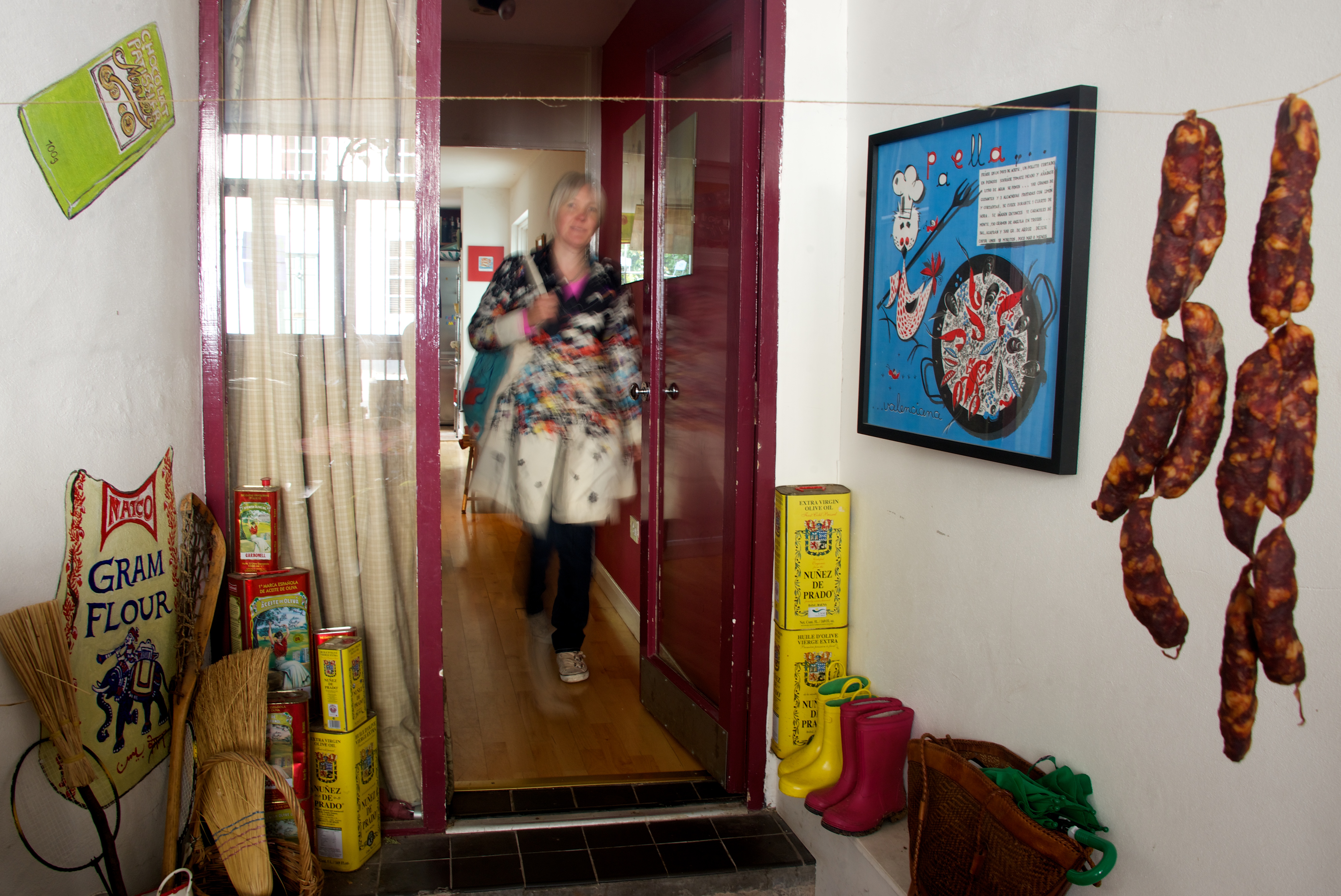
I’ve always been a serious chorizo fan. The cured Spanish sausage, seasoned with paprika and garlic, can transform a pot of beans or lentils like nothing else. I have to say that I’m more excited about today’s chorizo than ever because I actually made it myself (but more of that later). Pete’s relieved that the sausages are finally in the fridge after virtually garotting himself on the makeshift curing line. Imi and I rather enjoyed having to limbo our way out of the front door.Chorizo at Plum Cooking
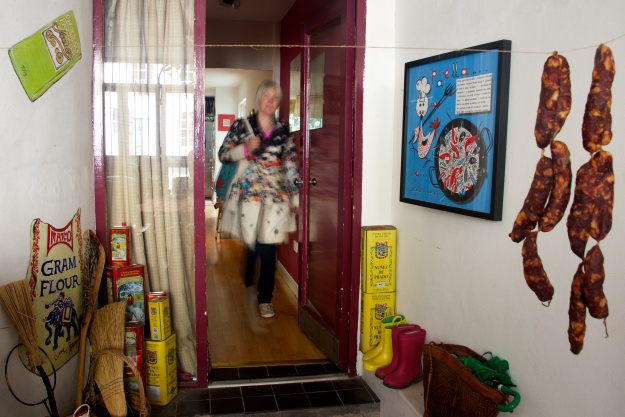
I’ve now got enough sausage for a number of dishes, since a little chorizo does go a very long way. I prefer using the soft cooking chorizo although after 6 days of curing my sausages are on the firmer side. I’m not too distraught as I’m sure that there must be some region of Spain where my chorizo would be considered true perfection. There is no single, truly authentic chorizo: some that come in strings can be as soft as a British butcher’s sausage, others come as firm, semi-cured horseshoes whilst you can also buy fully-cured versions to eat like salami. There are probably as many types of chorizo as there are cathedrals in Spain. So, my only words of wisdom: reserve the fully-cured for charcuterie platters or sarnies, chop the firm semi- cured versions into tiny dice for cooking (or it’s like eating leather) and keep the soft cooking chorizo in juicy hunks.

So here’s a basic recipe that appeared in my first book The Food of Northern Spain (I included another version using beans instead of chickpeas in my second, The Real Taste of Spain ). It’s best made a day ahead so that the flavours develop and the chickpeas (or whatever pulse you’re using) drink up the juices. You can obviously play around, it’s a what-you’ve-got-in-store type of a dish.

One-pot Chorizo Supper
Serves 4

2 tbsp olive oil
2 onions, diced
2 cloves garlic, diced
250 g/ 9 oz chorizo, hot or sweet, sliced
500 g/ just over 1lb of freshly cooked or 2 x 400 g/14 oz cans of chickpeas
1 x 400 g/ 14 oz can of chopped plum tomatoes
2 tbsp sultanas
juice of ½ lemon
salt and pepper to taste
1 tbsp toasted pine kernels
1 tbsp fresh parsley, roughly chopped
drizzle of extra virgin olive oil

Fry the onions in a large pan until they soften and then add the garlic and the chorizo. Once the pan is swirling with the smoky, red chorizo fat then tip in the chickpeas, stirring to cover them in the delicious oil.

Add the tomatoes and the sultanas and cook until everything is heated through.

Taste, I usually find that the chickpeas need a little lemon juice to liven them up and a bit of salt and pepper. Now sprinkle with pine kernels, parsley and a dash of extra virgin olive oil.

How about?
Using beans such as butter beans, cannellini, borlotti or black beans instead of the chickpeas.
Adding diced vegetables such as carrot, celery or red pepper to fry up with the onion.
Try stirring in some fresh spinach, right at the end, just until it wilts.

& for an instant Tapas nibble
Just try placing some chunks of sliced chorizo in a clay cazuela or oven-proof dish. Cover with red wine or dry cider and place in a hot oven for about 15 – 20 minutes until the fat just begins to glisten on the surface. Serve with great bread for dunking.

And now to the source of my fabulous chorizo: The Meat Course at Trealy Farm

Last weekend I went on a course run by Ruth Tudor and James Swift at their  Monmouthshire farm. I felt, like most of us, that I’d lost connection with where our meat comes from (horsemeat?!) and although I’m already very choosy when I’m shopping I just wanted to understand a bit more about the reality of rearing animals for meat, the slaughter, butchery and then some charcuterie too.

I hope that the pictures can begin to convey the bucolic setting (oh what a classroom, looking out over the Welsh countryside). My only regret is that I didn’t take any pictures of the amazing food that Nicky cooked all weekend, I was just too busy eating!

The animals were beautiful: I’m in love with Gwenlas the cow, failed to take any pictures of the pigs as I was having such a great time scratching their backs and discovered that sheep, depending on their breed, can be very different, and sometimes very endearing characters. Ruth chatted to us about the running of the farm, the constant decisions, obstacles, compromises and whilst I’m not about to run a small holding, I do feel that I’ve got more of a grasp of the differences between and the consequences of organic, natural and more industrialised farming.

I was definitely feeling pretty emotional and reluctant about the slaughtering of the sheep, but it was actually fascinating, and seeing the humane way in which an animal can be killed has made me even more determined to eat meat from animals that have been properly cared for.

Trealy Farm Charcuterie has been lauded by countless chefs and food writers as the best in the land so Sunday with James was an absolute treat. We kicked off with an English breakfast, some very, very good black pudding playing the starring role. We learned to butcher a sheep and a pig, talked about cuts and cooking methods and then finally, after a superlative charcuterie fest’ of a lunch, made our own bacon and chorizo. What a weekend; I might even pop back over the Severn Bridge and buy half a pig I feel so inspired.

Pan Con Tomate

Pa amb TomaquetThis morning there were two rather soft, slightly wrinkly tomatoes lurking in the fruit bowl, they had pan con tomate written all over them. Why put tomatoes in the fridge? So many shop-bought tomatoes are like bullets anyway and even the most unpromising, cotton -wooly specimens can only improve with a couple of days maturing on the side in the kitchen. If you do happen to forget them for a few days, and they’re past the firm tomato salad stage then they’ll be perfect for squashing on some good toast; the Catalan answer to bread and butter.

I ate my first toasted bread, rubbed with garlic, tomato and then doused with wonderful olive oil, as a child in Ibiza. My memories of the tiny Balearic Island are a million miles from the wild nightclubs that most people that most people think of. My grandparents moved there in the ’60’s and my sister, Libbus, and I spent holidays trudging down the dirt track through the pines to the beach, visiting hippi markets, eating the best peaches in the world, watching geckos and getting sunstroke (thankfully just the once). This month we finally said good bye to Ibiza Gran, who had reached the incredible age of 100. She was a legend: worldly-wise, fabulously outspoken, with a superbly exotic wardrobe (that used to fill me with dread as a teenager) and an unmatched talent for “Spanglish”. As we sat down on the beach at her favourite restaurant Ses Boques (below Es Cubells) I just had to dive into a plate of gambas a la plancha and some pan con tomate with a glass of vino rosado, to toast her on her way. Gran would have been tucking into the alioli too (the feistily pungent garlic emulsion served with bread); she always maintained that garlic was key to good health and long life.

But back to the business of the bread and tomato. It is quite simply one of the very most surprisingly delicious things to do with a tomato and so, so much better than just slicing it onto a piece of bruschetta.

You will need, per person:
A couple of slices of country, rustic or sourdough bread
1 clove of garlic, sliced in half lengthwise
1 very ripe tomato, cut in half equatorially
A dash of extra virgin olive oil
A good pinch of salt

DSC_7725

The bread is great toasted on a ridged griddle, or better still on a toasting fork over an open fire, but an everyday toaster will do the trick too. It’s definitely not the moment for brown or granary bread, most Spaniards still think that you must have some distressing health problem to even consider eating the stuff but, more to the point, it doesn’t work as well here.

Rub the toast with the cut side of the garlic clove, it’s amazing how much flavour the bread soaks up.

Now squeeze the tomato directly onto the bread, you want as much of the soft flesh as possible, the skin gets thrown out. You can grate the tomato half at a time and you’ll be left with the just the skin in your fingers, it’s a restaurant trick, but I always prefer to squash and squeeze my own.

Drizzle with some delicious extra virgin olive oil (I love the Spanish oils extracted from the tiny Arbequina olives) and sprinkle with a pinch of salt. Dive in whilst it’s warm.

Pan con Tomate makes a great snack alongside other Tapasy bits like tortilla, calamares or fried artichokes. You could have some, D.I.Y. style, at your next barbeque or you could indulge, as I did, with some sublime Ibérico ham.DSC_7728

And here’s just a glimpse of idyllic Ibiza, for those of you who might think that it’s all about  sweaty DJs, pedalos and cheap sangria. OOh I could do with a bit of that right now.